
South Bend Directory Years
South Bend city directories survive as overlapping collections, not a continuous annual set. The Indiana State Library verifies publisher and year holdings, SJCPL catalogs local microform and special titles, and other institutions supply individual volumes. Start with the year nearest the event, but verify the catalog before assuming the next year exists. Publication gaps are evidence limits and must not be filled by projecting a listing forward.
| Collection | Years | Where held | Access |
|---|---|---|---|
| Holland's South Bend City Directory | 1869-1870 | SJCPL | Microform and in-library research |
| Farr directories | 1883, 1886-1887 | Internet Archive; Notre Dame Archives | Free scan or archive |
| South Bend Blue Book | 1909-1910 | SJCPL | Library access |
| Hibbard directories | 1914, 1916, 1919 | Indiana State Library | Print or microfilm |
| Polk directories | Selected years, 1920-2015 | State Library and SJCPL | Discontinuous; some Ancestry access |
| Haines criss-cross | 1972 and later locally | SJCPL | Address-first, generally in-library |
The Polk list includes an incomplete 1929 volume and many absent years. A gap does not prove no book was issued, but the named collection cannot support that year. Check the State Library holdings guide for exact dates and call numbers.
The guide separates verified volumes from an assumed annual run.
Digitized South Bend Directory
William L. Farr's 1883 volume is the most usable free scan. Its 276 pages contain an alphabetical list, classified businesses, a street directory, public officers, and an abbreviation list. The introduction says the canvass followed street renumbering and estimated about 20,000 people with roughly 6,000 names. Those are publisher estimates, not census totals.
Open the digitized 1883 directory to search OCR or turn scanned pages.
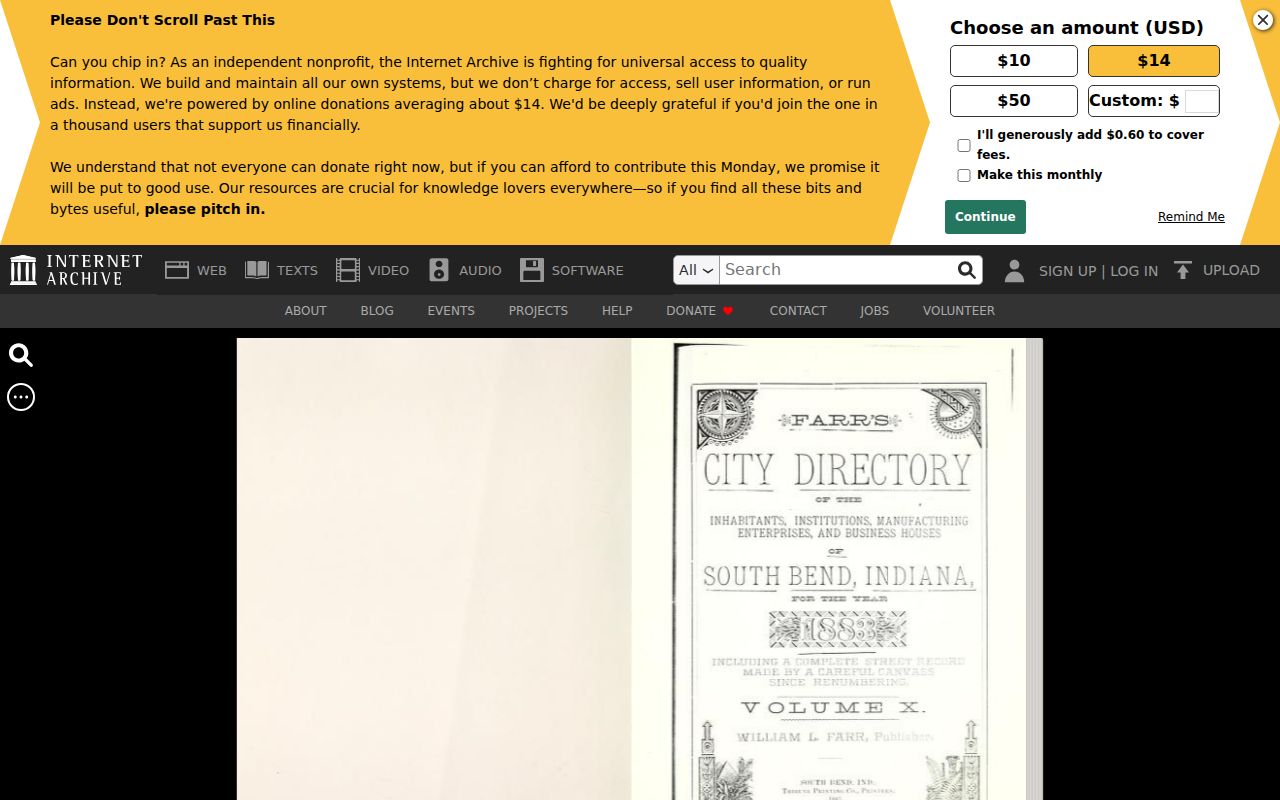
Search text finds names fast, but the page image controls when OCR misreads old print.
South Bend Library Research
SJCPL is both a catalog stop and a fallback. Its database list includes Ancestry Library Edition at library locations, FamilySearch, HeritageQuest, Digital Sanborn Maps, newspapers, a local obituary index, and Michiana Memory. Card and in-library rules vary. A person who cannot visit may submit the Local and Family History Query Form with a name, address, narrow date range, and precise request.
Staff do not conduct an open-ended family tree project. Published terms are $10 per hour with a $5 minimum, usually one to four weeks, and generally no more than one hour. Charges apply even when no item is found. A focused obituary, notice, or article request gives staff a solvable task.
Browse Michiana Memory for maps, photos, yearbooks, newspapers, and local documents.
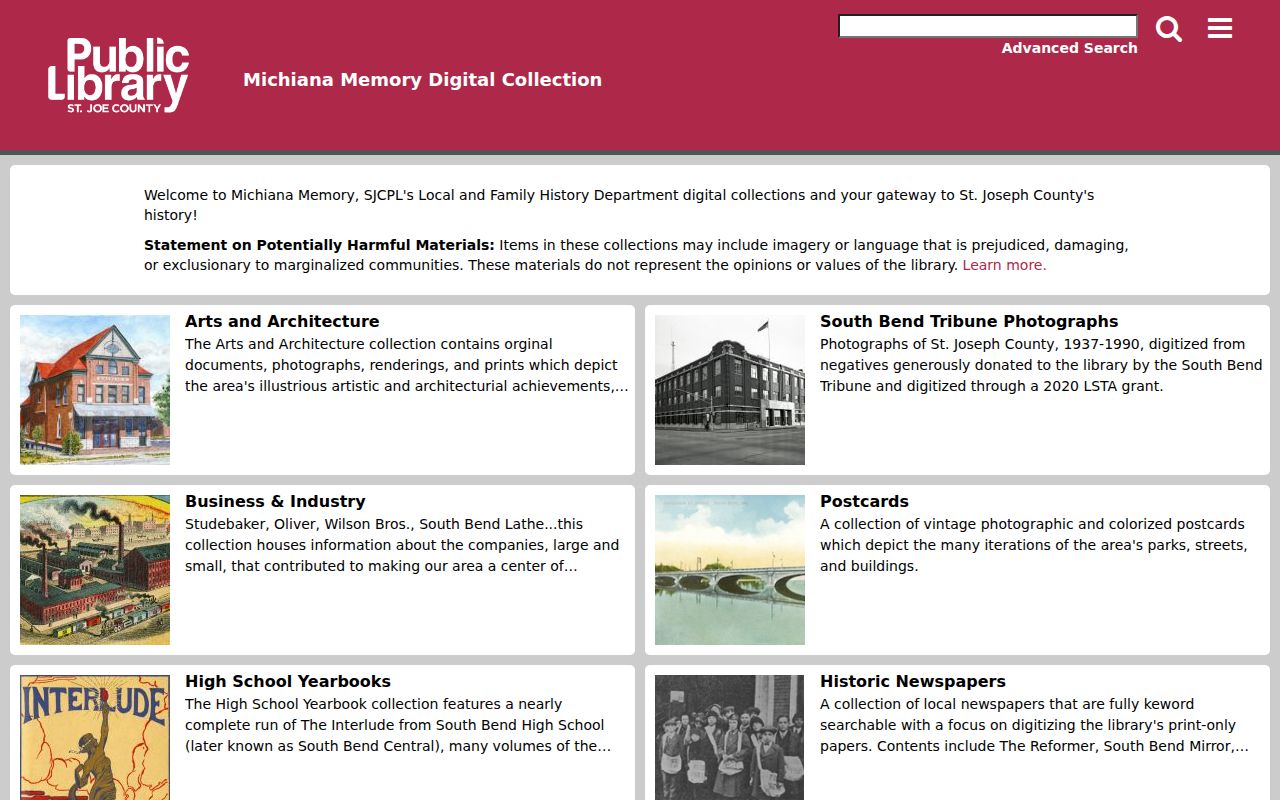
These sources can explain a directory address even when they do not reproduce its page.
Read South Bend Directory Entries
An 1883 city directory line can hold several address types. A residence, boarding place, workplace, and business site are not interchangeable. Verified entries include a Singer's worker with a West Marion residence and another worker boarding on South Michigan. Copy the line as printed, then expand short forms with that volume's own key.
| Name | Surname and given name as printed |
|---|---|
| Work | Occupation or employer, sometimes with a business address |
| Residence | Address marked as residence, distinct from work |
| Boarding | A boarding address, often shortened as "bds" |
| Family note | Spouse or widow notation when supplied |
| Change | A correction or removal note in some entries |
- Criss-cross directory
- An address-first volume arranged by street and house number.
- Householder index
- A list centered on the person identified as head of a household.
- Abbreviation key
- The book's list explaining forms such as "res," "bds," and "wks."
Never turn "bds" into ownership or "res" into proof of a present resident. Save the year, publisher, page, spelling, and address role.
South Bend Criss-Cross Years
Reverse directories change the search direction. Locate the street and house number, then read the listed name or phone subscriber. The Library of Congress inventory identifies South Bend and Mishawaka holdings for 1950-1956, 1964-1965, and 1972-1995. SJCPL catalogs Haines material from 1972 onward. The party shown may be a subscriber, owner, business, or another listed party, not every occupant.
Consult the Library of Congress criss-cross guide before requesting a volume.
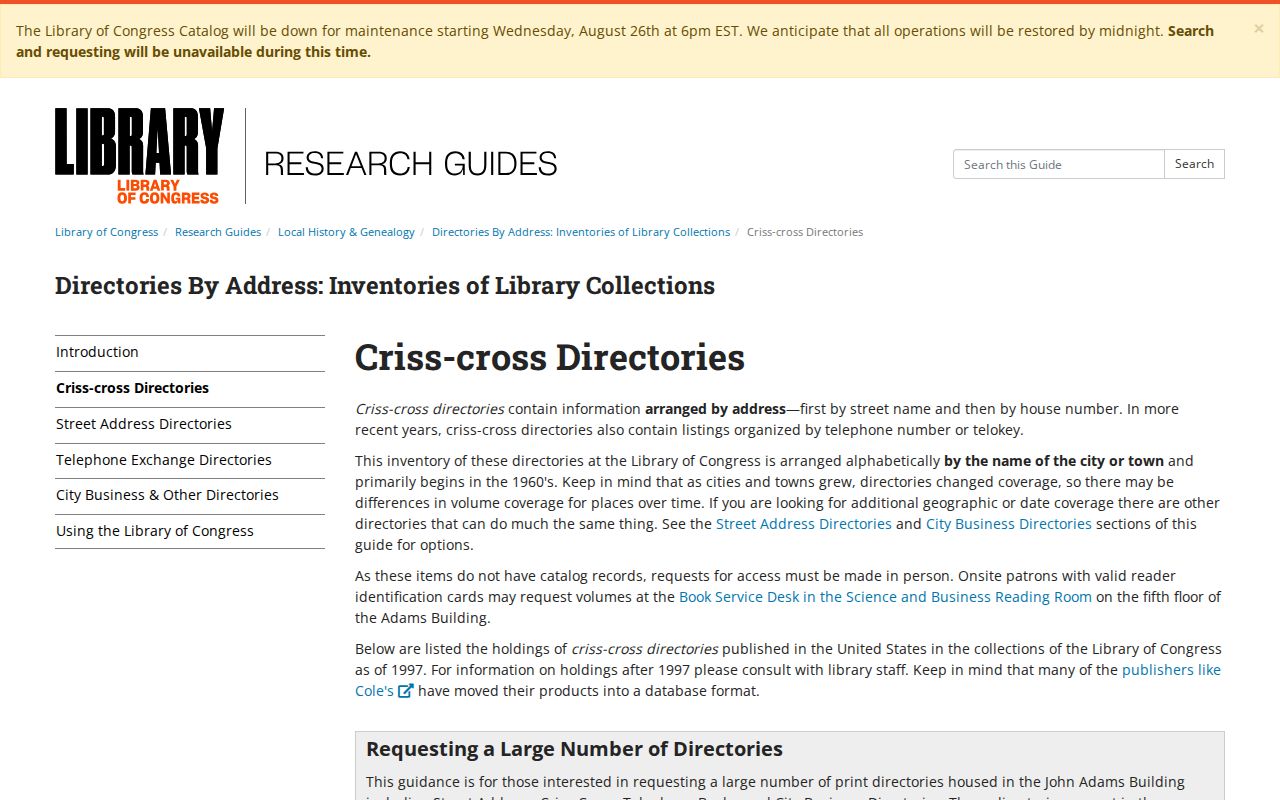
The guide explains why requests need a city, directory type, and exact year.
South Bend Address Renumbering
The 1883 directory followed a careful canvass after street renumbering. That fact makes it useful and risky. An 1869 number cannot simply be matched to an 1883 or modern number. Search the street list, compare cross streets and nearby businesses, then test the site against a plat or Sanborn map.
| 1869-1870 | Holland's book supplies an early address frame. |
|---|---|
| 1883 | Farr's post-renumbering book has name and street lists. |
| 1885-1949 | Selected Sanborn maps add building footprint and use. |
| Modern check | Parcel and deed records test the site after reconciliation. |
Keep the old number in the notes. Put a modern address in a separate, labeled cross-reference field.
Trace South Bend Family History
City directories bridge gaps between census schedules. Follow a household across verified publication years and note each spelling, work, address, and family change. Then pair the line with a census, obituary, cemetery index, probate lead, or newspaper item. South Bend Area Genealogical Society indexes are leads, while the original office remains the source for certified records.
- Save the first listing's year, publisher, page, and exact wording.
- Check the next available volume and note moves or name changes.
- Use a street or criss-cross section to test the address.
- Pair nearby directory years with 1870, 1880, or 1910 census material.
- Test a disappearance in obituary, cemetery, probate, or newspaper indexes.
A missing person may have moved, died, changed a surname, joined another household, or gone unlisted. The directory alone cannot decide. For modern records, use the South Bend resident lookup rather than projecting a historic line into the present.
South Bend Archive Network
The St. Joseph County Archives routes historic county and city material. Notre Dame Archives holds Farr's 1886-1887 volume. The History Museum and Victor Bendix Research Library provide house and local context. SJCPL supplies catalog, database, microfilm, and limited query help. The State Library adds guides, directories, and Sanborn maps.
Each access channel solves a different problem. Start online with the free 1883 scan, Michiana Memory, SBAGS indexes, and the State Library guides. At SJCPL, ask about microform, subscription databases, the local obituary index, and the cataloged Blue Book or Haines volumes. If travel is not possible, send the library's limited query form rather than a broad family-tree request. Contact Notre Dame Archives for its described Farr volume and the History Museum for a focused local-history question. County Archives staff can route an identified county or city record, while the original Clerk, Health Department, or Recorder remains responsible for an official copy of records created by that office.
Visit the History Museum research collections when a directory result needs more context.
The museum route works best with a dated name, address, place, or event.
Companion sources answer questions a city directory cannot. Sanborn maps show building shape, material, height, use, and nearby structures for selected South Bend years from 1885 through 1949. Newspapers may explain a business opening, death, move, or civic role. SBAGS indexes cover estates, divorces, wills, burials, naturalizations, name changes, and Victorian newspapers, but an index hit is only a route to the underlying record. Indiana Legacy adds free statewide searching by record type, keyword, county, and event. Save the index title and source reference before requesting an image or certified copy. That source chain keeps a promising same-name match from becoming an unsupported identity claim.
The 1909-1910 Blue Book deserves its own caution. It can supply addresses, telephone numbers, Notre Dame faculty, institutions, prominent residents, and nearby-city context, but it was not designed as a complete roll of South Bend residents. Likewise, a Haines criss-cross result reflects the listed party tied to an address or phone. Compare either source with the alphabetical city directory, a dated newspaper, and a public record that fits the question. Agreement across independent sources is stronger than repeating one publisher's line.
County and state archives also matter when a directory points to a life event. St. Joseph County Health publishes a genealogy application for qualifying historical searches beginning with county records from 1882. The Indiana Archives explains the split between county and statewide vital series, while certified modern copies remain subject to identity and eligibility rules. Use a directory name, address, and year to frame the request. Ask for a specific record series rather than an open-ended biography, and preserve the archive citation even when the search returns no match.